Sunday, July 6, 2014

Update from Camp Pendleton 2014


Hello Friends! It has been over a year since I last wrote to you from the wardroom aboard the mighty USS Germantown. This last year has kept me incredibly busy as I have moved on from being a Platoon Commander, to Company Executive Officer (XO) and ultimately a Company Commander (CO). I will continue to be a Company Commander in Camp Pendleton until I finish my time in 5th Marine Regiment this Fall.  As many of you already know I will be leaving the Marine Corps 9 December of this year. I will stay in the Reserves and apply to business school for the Fall of 2015. 

I uploaded all of my previous letters if you care to read them. I laughed a good bit looking back on them. Anyway, life is pretty busy these days so I am going to change up the format of these updates. I'll post pictures and write a bit. Hope all is well. 

-Dominic

****

May 2013: this is my medium machine-gun section after a great shoot in Okinawa. As you can tell they are some pretty lovable goofballs (check out the old man pipe).


May 2013: This is Weapons Platoon, Apache Company 1/5 prior to going on escape and evade land navigation training. 


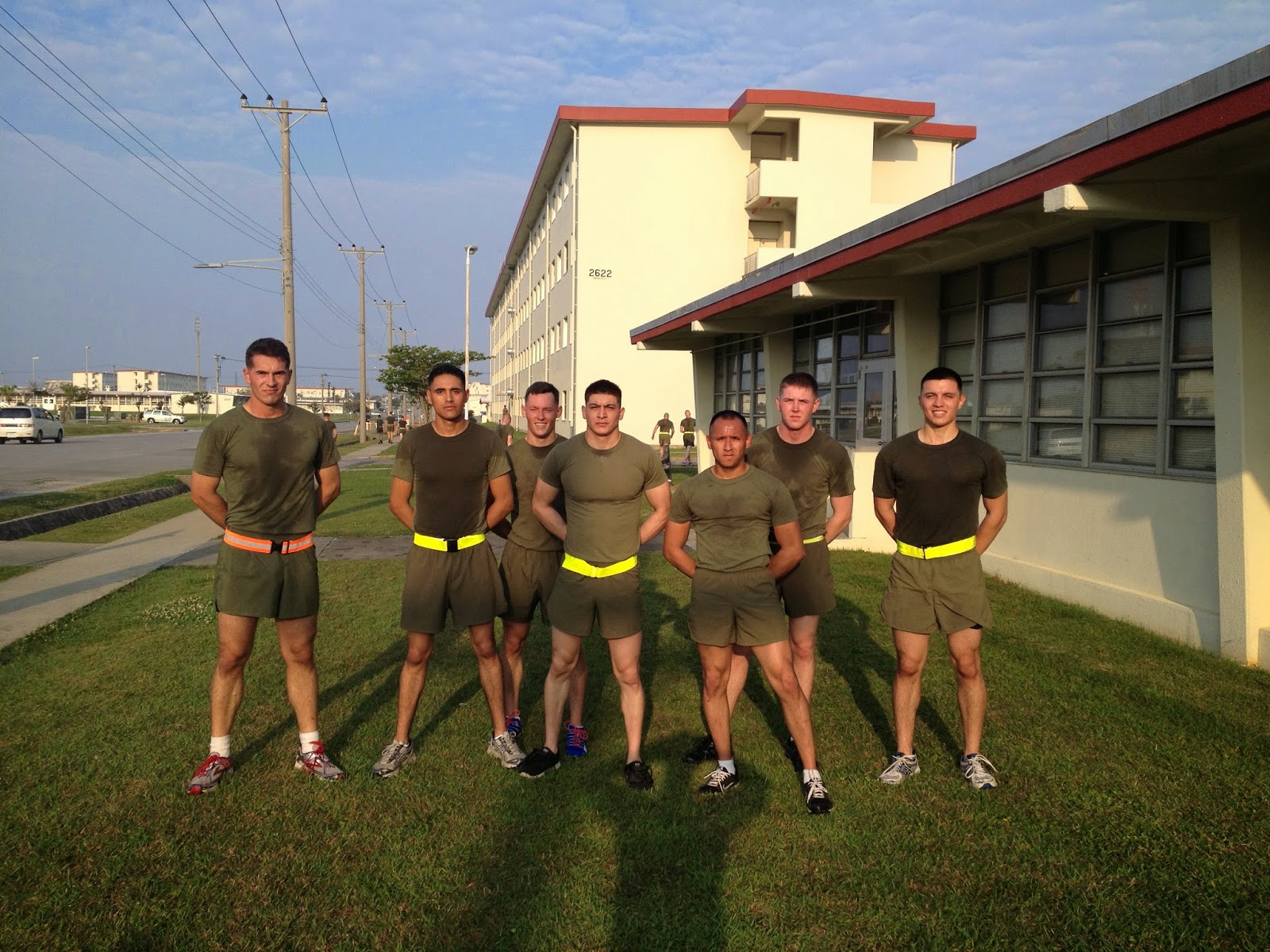
May 2013: this crew all got a perfect score on the annual physical fitness test. 


Summer Mountain Exercise, October 2013: my battalion went to the Mountain Warfare Training Center in Bridgeport, California. The event was called "Summer Mountain Exercise 4-13". It was an odd naming convention given the markedly winter style conditions. 


Summer Mountain Exercise, October 2013: any decent infantry unit will "stand-to" at sunrise and sunset for about an hour. This means that all men will go to their battle positions. The change in light presents certain advantages to the attacker and necessitates a heightened security status. This photo was taken in the early morning on top of hill 9494 (elevation in feet).


Summer Mountain Exercise, October 2013: I snapped a photo of this camp Fumanchu moments before this Marine got snatched up by the Company First Sergeant. The inappropriate use of cammie-paint provided some much needed relief. 


Summer Mountain Exercise, October 2013: This might be my favorite photo of the year. For most of 2013 I served at the Executive Officer (XO) of Apache Company. The four other Marines in this photo were part of what was called "Bravo Command". We were the alternate command node for the company. I spent most of October rolling through mountains with this small team. As the XO one of my most important tasks was to maintain communication with the battalion (two of our radios are visible, we had others and usually carried a field antenna as well). This often caused me to break off from the Company to seek higher ground (radio waves). It was quite an experience traveling through the beautiful countryside all by our lonesome. The views we took in and the places we hiked were simply breathtaking. 


Summer Mountain Exercise, October 2013: awaiting extraction in Grouse Meadows with two fellow Lts, Alex and Dennis. 


Marine Corps Marathon 29 Oct 2013: completed this race in 3:57, the week after returning from Bridgeport.


10 Dec 2013: on my 3rd Marine Corps birthday I ran a live-fire attack with Apache Co 1/5. This a picture with all the Company Officers. You can see a frozen ball of ice on my compass. Don't let the desert utilities fool you. It was cold!


Friday, March 1, 2013

Westpac Cruise 2013


Greeting from the Western Pacific!
I am aboard the mighty (sorta) warship USS Germantown cruising around the Western Pacific as part of the 31st Marine Expeditionary Unit. In plain speak we are an air-ground-logistics group of about 2k Marines ready to react to any emergency in the Pacific region.  My company in particular is an amphibious mechanized company, meaining we have troop carrying vehicles that can swim to shore and drive on land (Assault Amphibious Vehicles or AAVs if you want to look it up). We’ve been underway for several weeks now cruising around theWestPac with a stop in Thailand. Okinawa was fairly dull, but ship life and our training exercise in Thailand have some things worth relating.
Navy Life
The Company loaded up on our “small deck”amphibious landing ship in Okinawa. The CO and I stayed behind in order to conduct some staff exercises (I was serving in my capacity as a fire support advisor). After giving a brief to the Colonel on our work, we readied to fly out to the Germantown. That is when the adventures began.
Due to some complex air scheduling we were unable to fly directly to our ship, but rather fly to another ship and proceed by small boat to our final destination. A CH-46 helicopter picked us up from the baseball field aboard Camp Hansen. We lifted into the sky and sped our way out to sea. Just off the coast a low hanging marine layer pushed our flight path down to just a few hundred feet above the water. Skimming across the water in an old CH-46 air frame is not the pleasure cruise you may think of if you have taken a commercial tour chopper. The rotors sound like a chainsaw being turned on a cement block. The back is open, and it gets pushed around in foul weather. I am glad we are not in Helo Company.

We reached our first ship without incident. As they shut down the flight deck and readied our launch, I laid down for some much needed rest in a concealed nook. I quickly fell into a deep sleep, slumped as I was in my life jacket. After an undeterminable amount of time I was awoke to a loud “Let’s go!”. I shot up with all the trained fury of an Officer Candidate. In my half-asleep dazed state I smashed my head full force into a beam. Within half a minute I had a small swamp of blood on top of my head. I gingerly fastened my helmet as they lowered our boat into the crashing waves below (sea state 3 for you insiders out there). A rope ladder led 30 feet down to the small boat, bouncing beside the hulking frame of the ship. I checked my life-vest and clambered down the side of the ship.
Our launch began cutting our way through the waves towards our ship, just barely visible on the horizon. No sooner had we turned away from the hull of the USS Tortuga than a wave crashed over our bow soaking me head to toe. I looked at my buddy, a prior enlisted lieutenant with 18 years, and we just began laughing. Before our 45 min boat ride was over every passenger was soaked to the bone. It was January 23rd - my birthday .

Ship life is pretty good. I live 2 men in a 4 man stateroom. My roommate is another 1st Lt, Andrew Long. He had 8 years enlisted in the reserves before he became an active duty officer. He’s a cool dude, and as a former personal trainer – so a good roommate. The food aboard ship is excellent by military standards. It’s usually tasty, and always healthy and filling (not always the case at Marine Corps bases). Due to the tight confines training is mostly done on a small unit level. Aside from my supervisory duties that leaves my fellow lieutenants and I plenty of time.
We fill our days with a lot of reading and a ton of working out. Our normal routine is to work out twice a day. We do a lot of Olympic lifting outdoors - not a half bad way to pass the time. Otherwise I go running a lot in the well deck. The well deck is the true belly of the ship. It is where all our AAVs park. It can be flooded from the back where AAVs can launch out to swim ashore. It is also where we store (sectioned off from the water) our Artillery pieces and several trucks. It’s got a pretty cool industrial feel to it. A long thin path can accommodate several joggers if constant turn arounds don’t bother you. I’m training for the San Francisco Marathon in June so I’m pretty happy to at least have somewhere to keep training.

For reading I just finished the The Mission The Men and Me. It is a phenomenal book about leadership applicable to any human endeavor. I also knocked out a philosophy book, Man’s Search for Meaning, by Viktor E. Frankl. Not of the military genre, but a good read from a good friend. I’m currently slugging through General Slim’s 550+ page account of the WWII Burma Campaign. This is truly an undertaking only to be attempted when in confinement, either penal or naval.
The Navy does have some fun too. When we set out from Okinawa we caught up to our sister ship, USS Tortuga. The Ship’s Captain, Cmdr. McKenzie, played classic rock over the PA, flew the Battle Ensign (really big flag) and started turning donuts around the Tortuga at high speed. About every week we do an all-hands ship cleaning – blue and green. They make it a little fun by playing music over the ship’s PA. The selections are generally some solid gold oldies. It’s a pretty classic scene scrubbing down a ship from the Johnson Administration and listening to the same music. They also play a lot of Motown love songs for all the lonely souls (of which there are many among the Japan based Navy crew). We had a lot of fun on the Superbowl, which was a ship holiday. There were Officer and Enlisted viewing parties. All the infantry officers had the opportunity to serve ice cream for the Marines. That was a lot of fun. All in all shipboard life aint bad. We’ve seen some beautiful ocean and coastline, and gotten a much needed break from the hectic drive of dry land training.

!!!Ying Meang Ler-y!!!

Our trip ashore was a joint US-Thai training exercise called Cobra Gold in and around Ban Dan Lan Hoi. The main effort was a joint live-fire attack involving US-Thai infantry, mortars and artillery. My job was to make sure that all 7 of the Thai and US fire support agencies fired (live ammo) according to plan during the attack. Everything was planned to the last detail to ensure the best show for the assembly of Generals, diplomats, officials and international press. The several days prior to execution were a trying experience. Hazy weather and wild fires clouded our vision so that we could only register and rehearse firing on one day of the five planned. The toughest part though was that we did not have a translator. Attempting to cooperate firing full size artillery with a language barrier is tough, to say the least. We were blessed to have one Thai lieutenant who spoke some broken English. Lt. Egg, Thai Marine Artillery, was the critical man in our operation. I was his main US liason as we tried to bridge large differences in doctrine, protocol and language. We had particular differences over approval (safety checks) of firing. The Thais don't do things the way we do. The result was a lot of frustration and hesitation to shoot.

However, Lt. Egg was a hell of guy with a great attitude. Under pressure of both of our chains-of-command to do it our way we figured things out. The term “ying pai lew” is the official firing command in Thai. Part of my job was to tell Lt Egg when the Thai agencies were approved to fire. The term I used, which was to become our unofficial motto, encapsulated the spirit of Cobra Gold for me. Just before H-Hour I turned to Lt Egg, and whispered: “Ying Meang Ler-y”. Loosely translated that means “Fire that Shit!”

I am now back aboard the USS Germantown eating good chow and relaxing. We’re going to cruise around for a little bit, then head back to Okinawa. Once we get back we only have one more weeklong field op. We’ll start packing up at the end of April. Our flight window to return home is 15-25 May. I have leave 1 June to 16 June. I’ll be in SF for part of that, and for the SF Marathon on 15 June.

Let me know what you all are up to.

See you soon, Semper Fidelis,
Dominic
PS. The third photo is my Fire Support Team (minus our artillery officer and radio operator who was elsewhere). They are from left to right: Sgt Gallegos (mortars) Lance Corporal Szmergalski (radio operator) and Corporal Finch (artillery scout) and I'm far right. When I'm not looking after weapons platoon I spend a lot of time with these guys on a hill somewhere. I call Szmergalski, my radio operator, the hardest working man in showbiz.


Monday, October 1, 2012

Camp Pendleton I


All stations this is Apache 4
Greetings from Camp Pendleton, CA. I’m sorry I haven’t written in so long, but I’ve been pretty busy since we last talked. I graduated the Infantry Officer Course in September 2011 and checked into 1st Battalion, 5th Marine Regiment in October 2011. After a short stint as a Rifle Platoon Commander, I took command of a Weapons Platoon (same Company, call sign now APACHE 4). We are scheduled to go on a Pacific cruise in December for several months. We will train with some allied militaries as well as hit a few ports of call. If anything should happen in that part of the world, we will respond. 
As the Weapons Platoon Commander I am responsible for training the ~50 weapons specialists organic to the Rifle Company. My Platoon is organized into 3 sections: Machine Guns (M240G Medium Machinegun), Mortars (M224 60MM Mortar), and Assault (responsible for rockets and demolitions). The Platoon itself will never run its own missions, rather I will attach my Marines to rifle platoons that need weapons support. Once I give my guys up, I assume the duties of the Fire Support Team Leader (aka FiST). I will be responsible for planning, coordinating and executing all fire support for the Company. I have at my disposal a team of observes and radio operators. I will work with Mortars, Artillery, air support, Weapons Company (really heavy weapons), snipers and naval guns. I also help the Executive Officer run the Combat Operations Center. If it sounds like a job with a bunch of varying responsibilities, it is. The billet is supposed to be filled by a 1st Lt, but we do not have enough. It was a real challenge at first because the job requires a quantum leap in technical knowledge, but I’ve got a handle on it now and am doing just fine. Some links if you’re interested:
- Assault http://en.wikipedia.org/wiki/Shoulder- launched_Multipurpose_Assault_Weapon
Being a Platoon Commander has been one of the most demanding yet rewarding experiences of my life, and I would not trade it for anything. I have had the opportunity to lead between 50 and 55 young men while in this position. It’s taken a lot of work, much of it tedious, but I am really glad with how the guys have come along. Our Company has been pretty successful during evaluations, and it is in no small part due to the skill and hard work of my guys. 
***
Every Friday Platoon Commanders are required by Marine Corps Order to give what is called a “Liberty Safety Brief”. The idea is that a senior member of the unit talks about staying out of trouble. Many units treat these as a perfunctory “check in the box” activities before securing to the weekend. Liberty safety briefs happen to be my favorite time of the week, because I use it to talk tactics with the guys. I execute what are called “tactical decision games” or “sand table exercises.” I brief my men a situation over a large terrain model. These terrain models are measured in yards and the height of the buildings reaches knee high. For the next 30 minutes or so Marines talk about what they would do. The emphasis is on junior Marines to offer their ideas. It is a great way to teach tactics, build the public speaking skills of junior Marines, and demonstrate that your Marines opinions matter to you. At first the situations I briefed to the men fell flat and participation was minimal. Now every Friday they fight to give their opinion during the limited time we have. It is pretty cool to see the Marines take an interest and speak their minds. 
***
Our Battalion Commander places a significant priority on being able to move on our feet – he believes in old school infantry. About every month we go on a Battalion Hike, working our way up to 26. Our last hike was 20 miles. It took 8 hours and 44 minutes. Since we are a Weapons Platoon, we carried our all of our guns. We marched through the nigh because of the heat. It was quite an experience.
***
If I had to single out an important event from the last several months it would have to be our live-fire Company attack at Marine Corps Base 29 Palms. Out in the middle of the California desert we executed a full attack on 3 trenches with M16’s, medium and heavy machineguns, rockets, 60mm mortars and 81mm mortars. As the FiST leader I played a significant role directing all the supporting arms. Throughout planning and execution I was in my CO’s hip pocket making sure that our big guns were helping his scheme of maneuver. When he briefed the order to the reinforced company (over 200 Marines) I had the opportunity to brief my fire support plan to the Company. 
This was my first major live-fire operation as a FiST. I, therefore, planned everything by the book. I had every stage of the attack detailed on a scheduling worksheet. I plotted every target and safety rings on a 1:10,000 map. Before the attack the CO and me were called to the Battalion Command Post to brief the scheme of maneuver and get the safety approval. Our audience was the soft-spoken yet imposing Major Brock. He asked numerous specific questions, particularly regarding the safety of dropping 81mm shells in such close proximity to friendly troops. He seemed satisfied with the ground scheme of maneuver, but continued scrutinizing the fire support (bigger booms are more dangerous afterall). He expected sharp 1 sentence answers to his questions. After a long emotionless scan over my work he said, “Good job Bea.” As soon as Major Brock turned away my Captain grinned with relief as if he’d been holding his breathe the whole time. If there was a problem with a plan Major Brock would find it. Getting his approval without corrections was a big morale boost for the both of us. We would have high-fived had we not been standing right outside the CP.

My small team of observers and radio operators started the attack. We climbed to the reverse slope of a dominating hill and took cover in the crags. I crept up to the crest, surveyed the area, and gave the sign to the team to set up. With a clear view of the objective area we absolutely pummeled the objective with 81mm Mortars. Before the fight was over I would expend 270 rounds from Mohawak (81’s platoon).  
As the Company moved forward my radio operator and I went with them. I planned to coordinate the fires of my 60mm Mortars and M240 Machineguns closer to the fight. A funny thing happened though. When both these sections arrived they went straight into action. I watched as the section leaders made all the right decisions and took all the right actions in accordance with the order. Throughout the last 2/3 of the attack I quietly tracked the flawless execution of my mortarmen and machinegunners. I did not issue any orders – I didn’t have to. On the last trench we planned to employ a mortars smoke screen in support of the final push. I turned to my Artillery Forward Observer and mentioned how the wind was perfect to push our smoke screen in the right place. The next thing I heard: “This is Apache mortars, smoke shot!” The smoke landed in the right spot and laid perfect obscuration for the last assault. My section leader nailed it. I saw the evaluators give nods of approval and furiously scribble notes. 
The company attack was a great learning experience for me. I worked very hard on the fire support plan, but it went off without a hitch because of my subordinates. As a pretty junior officer I’m walking away with a valuable lesson and appreciation for my superb section leaders. 

***

Camp Pendleton has a lot of Buffalo. We were driving up through the mountains to the Southeast and when the fog cleared – sort of – we found that we had driven into a heard of about 200.


Picture of my platoon at the Mountain Warfare Training Center. I am far right. 
All of our training is done now. We will turn in gear, take leave and head off to Japan on 1 Dec. For those of you in the Bay Area I’ll be around 12 Nov - 15 Nov and 21 Nov – 25 Nov. I’m sorry I have been so bad about keeping in touch. The last year has just been an incredible amount of work. I miss you all very much.

Semper Fidelis,
Dom


Wednesday, July 6, 2011

Quantico Letter VI


Hello All!

I graduated TBS (The Basic School) and have already begun instruction at IOC (Infantry Officer Course). IOC is a 3-month school for Infantry Officers and Ground Intelligence Officers (scout sniper commanders), and it is the last school before I join the Fleet. I’ll get orders with my unit/duty station in a week or two, and I’ll graduate IOC September 22. Training is tough, but I love it.

TBS was a great experience. Day to day it certainly didn’t feel like a life changing experience (I never got the opportunity to slay the lava monster like in the commercials http://www.youtube.com/watch?v=62tnJtLBQzQ). However, looking back at 6 months I got a lot out of it. TBS is the sculptor that works with a small chisel. Little by little you learn “those things you must do to be one of us, to be part of our tribe.” I don’t think I noticed along the way, but my mind, body and soul are not the same as they were when I showed up.
These things may sound trite or somehow unremarkable, but these simple words mean a lot in light of my experiences. For instance, you just get a different perspective on character when you look over at your roommate day 4 of a training exercise and see him persevering – and he’s a lawyer!

 Training At Its Best
The last part of TBS was filled with great training and experiences, but I’d like to share one experience in detail because it represents the training and creation of Marine Officers at its best.
Our last field training exercise covered MOUT (military operations on urban terrain). About 10 miles North of Camp Barrett there is a small 15 building Afghani Village. The buildings are made of cinder blocks and range from 1 to 3 stories. The buildings include anything from 1-room homes to a 4-story hotel. They’ve gone to some lengths to make it realistic. Buildings are furnished, signs are up outside and the streets are cluttered. The restaurants even have prepared food laid out (plastic props unfortunately). As you can see in the photos they even have a big billboard with Hamid Karzi’s face on it. Stuffed sheep line the street.


We spent 4 days there learning fundamentals of urban combat: isolation of the objective (i.e. prevent reinforcement), suppression of the objective (i.e. make the enemy take cover so your assault force can approach), obscuration, breaching and room clearing. They outfitted us with a special laser tag kit for added realism. Our rifles sent out laser beams that were picked up by receptor vests. If you were hit the vest would let you know if you were a casualty. As you can imagine it lead to quite a bit of competition.

On the 3rd day of the FEX I was tasked with leading a platoon assault against an urban squad defense. It was one of three repetitions of the culminating training exercise. I was very fortunate to be selected. At 1500 I received the order from my “company commander”. My mission was to clear buildings A1-A4 in order to allow the company to continue offensive operations farther North against the enemy. See map.

After some hot field chow, I reconnoitered the battlefield. I quickly identified A4 as the key terrain feature. It was a two level schoolhouse, 8 rooms per level with a roof. The other structures were simple homes with about 2-3 rooms. From A4 one could dominate the area, particularly from the roof. It was also the most defensible since all 16 rooms and roof would have to be fully cleared. I referred to A4 as the citadel (a reference to the Battle of Hue City). Conventional wisdom called for establishing a foothold in a smaller building (i.e. A1) and work in number order to the final objective. Whoever designed this training program did so in order to demonstrate and validate the textbook answer. The problem I figured is that my opponent would prepare for precisely that kind of assault. He would push forces out in front of A4 in order to execute a collapsing defense. He could inflict substantial casualties during my advance (A1, A2, A3), but escape in order to mount a committed defense in A4. (these were my assumption prior to the battle, which were later confirmed to be 100% correct).

I knew that fighting against a full squad defense in A4 would be disastrous (his center of gravity), even with my 3-1 advantage in men. The defense has a tremendous advantage on urban terrain. However, he had necessarily divided his forces in order to employ the collapsing defense (his critical vulnerability). This left me an opportunity. If I were to swing around the objective and strike A4 first I might encounter an undermanned defense. I would then be able to seize the most important objective, and one that would allow me to dominate the others, before he could bring his combat power to bear (my exploitation plan). Why fight 16 dug in defenders when you can fight 8 and destroy the rest piecemeal in the other buildings?

After lights out I walked over to one of the other buildings to get a little quiet to write my order (it’s pretty tough to keep focused when Marines are sharing colorful bedtime stories, I mean straight outrageous stories of libo exploits). As I said the Marines went to great pains to construct a realistic town, and I found a fully furnished office in one of the empty buildings. It looked like Oakdale, CA City Hall had liquidated all their furniture sometime in the 80’s and it all ended up on Marine Corps Base Quantico. I sat down to write at about 11 pm. It was about 95 degrees and I stripped down to boots and trousers to prepare my order in the DMV style environs. At about 1am I couldn’t see straight so I went back to the Hotel to get a few hours of sleep, leaving the logistics, admin and communication elements of my order to the next morning.

We were billeted on the 4th floor of a hotel (unfurnished of course), which was blazing hot even at 1am. Unbelievably somebody had left the balcony open where it was just cool enough to actually sleep. I flopped down on a foam mat in just my shorts to get a blessed 3 hours. An hour later I heard a medium machine gun rip off about 10 rounds. I shook my head thinking some idiot would have to explain a negligent discharge to Major Antolino. Then he tore off a 30 a round burst and I heard the whistling of an incoming artillery simulation round. Its burst was deafening in the cement block city. Within ten seconds I had my boots on and rifle loaded (blanks Mom, relax). I must have looked quite odd holding my rifle and wearing nothing but shorts, boots and my war face. Then the order came, uniform on, bring a pen, flashlight and rifle. As we assembled outside my platoon commander explained we would be taking a tactics written exam. In the glow of a red lens flashlight, with bangs and flashes going off around us, I worked through the short response exam. It focused heavily on weapons capabilities and principles behind defensive operations. I actually found the test fairly simple, but it was long and we didn’t finish until about 3am. Back onto the mat I crawled.

I awoke at 0400 and finished my writing my order. I rehearsed as I wrote the order, so that I had most of it committed to memory. At 0520 our self-appointed Company Motivator, Lt. Deiters screamed: “10 minutes to light, 10 minutes to lights, 10 minutes lights.” You may not be able to appreciate how much we wanted to shoot that guy if you haven’t been to Quantico, Parris Island or San Diego, but that was the daily warning for reveille at OCS/Boot. I hadn’t heard it since then, and the timing could not have been more ironic.

After a little ammo/chow/water coordination I brought the platoon in on a terrain model of our objective. I walked them through a detailed explanation of the situation and scheme of maneuver. We were located East of the objective near A1, and via a large swinging motion to the North, would move around and attack A4 from the West. We would call for 81mm mortar suppression to begin the attack. 3rd squad would “isolate” A4, meaning that they would orient fires down MSR Tampa to prevent reinforcements coming from the other building. This was key to my plan. I wanted to take A4 before other forces could get back. On order 2nd squad would open fire on the building to “suppress” the enemy. This would force the enemy in A4 to take cover, which would allow my assault unit, 1st squad to approach the building. Smoke grenades would obscure the last 20m of 1st squads advance and they would breach by the back window. As 1st squad approached 2nd squad would shut-off fires (to prevent friendly fire). 1st squad was to begin clearing with 2nd squad following in trace. I wanted to ensure my forces were overwhelming once inside the building.

I finished delivering the other parts of my order, the brief taking about 30 minutes in total, and we stepped off. Besides hitting an enemy observation post early I was able to position my forces fairly easily. We arrived undetected and set in. Earlier that morning I added a little deception to the plan (4th tenet of the infantryman, “make deception a part of everything you do”). I dispatched a 5-man team to create a diversion to the East, where the enemy expected my main force to come. I hoped to fix his forward positions long enough to start my assault on A4. The feint worked perfectly and kept my enemy focused east. I picked up my radio and called for the mortars. Real mortars didn’t start firing, but the laser tag system makes them take cover or they become a casualty. This allowed 3rd squad to move into position. My call sign was White 6. I called my 3rd squad leader, “White 3 this is white 6, we have effective suppression, move into position.”

“Roger that white 6, Oscar Mike, over!” (on the move). Shortly I would call over to my other units and get them moving. Then I still heard my 3rd squad leader talking to his squad. After his last transmission my 3rd squad leader had gotten his radio stuck on talk. We call it a “hot mike” and it prevents anybody else from talking on the net. I screamed for him to get off the net, but too far away and with rounds already cracking off he couldn’t hear me. 3rd squad was in position, and I had to radio for the other forces to get moving. The momentum of the attack halted. 2nd squad waited and waited for the radio call to start firing. The enemy soon figured out what was going on and began falling back to A4. 3rd squad sat too long unassisted by the rest of the platoon and was nearly wiped out. My hopes of assaulting an undermanned A4 were slipping away.

This all happened in a matter of half a minute. Realizing my radio was worthless I sprinted through the woods to 2nd squad. Some had started firing and others were hanging back. I would find out later that their squad leader was an early casualty. I took personal control of 2nd squad and got them into firing position. Ok I thought to myself, we’re getting back on track. By then my radios were back up and I called for 1st squad to assault. Smoke grenades poured out of the woods and soon I could see Marines flying through the billowing smoke.

Then all of the sudden something weird happened. My assault team piled up on the window and then stopped. I couldn’t understand. The one unequivocal law of urban combat is you’re always safer inside a building. The instructors were standing over the quickly dying team screaming to get inside the building. By this time I had already cut off 2nd squads fires, so I ran down to the breach point 100m away.

The appointed breach windows were barricaded and the assault team just stopped. Never mind there were six other open windows on the same side of the building. I grabbed Lt. Grant Hundley who had just showed up. “You, grenade in there!” Clunk, clunk, bang! I smashed the barricade took a knee and motioned for Marine use my leg as a step and get inside. About 8 Marines got inside, and I followed them through. My 1st squad leader, Lt. Matt Baumann did a magnificent job clearing the building. In about 3 minutes we had A4 secure. The instructors turned towards me and started firing questions. Where are your forces?! What are you going to do?! I looked around and only had the 8 Marines with me - many more lying on the ground, their laser vests buzzing with casualty information. I called in vain to my other squad leaders, both of whom were casualties. I knew that we’d taken serious casualties and we needed to consolidate before moving against the other buildings. I eventually got a hold of my platoon sergeant who picked up the last 4 members of 3rd squad and brought them into A4. I made a situation report to higher, “Godfather this is White 6, we have seized A4. We have a mass casualty situation, estimate 25 casualties. Dispatch QRF (Quick Reaction Force), over.” We had seized the main objective, but the unit had culminated.

At that point the instructors called “end exercise” and held a debrief to discuss my performance individually and that of the platoon as a whole. The general consensus was good plan, good order delivery, but mediocre execution. Some of that can be left up to the fact that it was our first platoon sized urban operation. There will always be hesitation the first time. Some of it was also laid upon the communication situation. We sustained the majority of our casualties during or as a result of the period of lost comm. As devastating as it was to lose communication during the crucial minute of the operation, I couldn’t blame my squad leader. Here was the great lesson of the operation. The “hot mike” was his error, but it is my fault that I did not have a robust “no comm plan.” As I wrote my order in the middle of the night I left out alternate signals using smoke, whistles etc.

As frustrating as it was, I learned a valuable lesson. Contingency plans, whether for bad communication or anything else, need to be well considered and detailed. The difficulties herein discussed could have been overcome with good alternate plans. When my assault team paused at the barricaded window there were 6 other ground floor open windows on that side of the building. A simple alternate breach plan would have kept the momentum up. Instead the team stacked up and stalled. This is a crucial lesson for leaders and one I will take to the Fleet.

At the beginning of this letter I said I would talk about “training at its best”. Mediocre execution with a bunch of hang-ups may not seem like such great training. However, these difficulties are realistic, and its good that we experienced and coped with them in training. It is much better to feel the effects of fatigue, confusion, and poor communication and achieve a 70% solution, than to execute an elegant scripted maneuver free of difficulty and friction. For an unsupported infantry assault on an urban objective, taking such heavy casualties seizing an objective should be expected (N.B. we do not do unsupported infantry assaults anymore, we call for air). In the end, what made this “training at its best” was that we experienced friction and still took the objective.

A Few More Things
I recently picked up at IOC. The Infantry Officer Course requires a high degree of confidentiality so I cannot say much about it. However, after getting a little familiarity with the school, I feel mentally, academically and physically prepared. I give credit for that to my platoon commander who enforced a high standard at the Basic Officer Course. We are through Week 1 and I am eager and ready to keep going.  
As I close this letter I want to thank everybody who has kept in touch. Your emails, calls and letters mean a lot. Thank You. The first two photos are of our urban combat facility. The last two are me with my roommates from TBS. I am in a very good frame of mind to tackle the last obstacles of training. I keep on thinking back to a piece of scripture the TBS Chaplain cited at our graduation. It captures my frame of mind. “Then I heard the voice of the Lord saying, whom shall I send? And who will go for us? And I said, Here I am Lord. Send me.“ -Isaiah 6:8. There are two Good Books in the Marine Corps. The Bible and the Catalog of Medal of Honor Citations. You can never go wrong with either one.
 Semper Fi,
Dominic

Tuesday, February 1, 2011

Quantico Letter V

SEMPER FIDELIS!

Greeting from the college of rock 'n roll knowledge! Instruction is roaring ahead here at The Basic School. The last two months have been furiousy busy with Infantry tactics, call for fire (both close air and artillery), more range time, military skills (land nav, chem/bio training), platoon operations, defensive positons and a little Company HQ training. The training is certainly challenging, but I am really enjoying it - especially the field time. We've spent about 3 of the last 8 weeks out in the bush. As I said my time is pretty constrained so this message won't have any fancy writing, but see below for the details. Editing is mediocre, please excuse me.

Speaking of rock 'n roll, the instructors here are nuts 80's pop. Classes are a mix of military knowledge and VH1's I love the 80's. The power point slides for our platoon defense class featured numerous references to "Pumping Iron" and spandex. Our Night-attacks class began with a clip from David Hasselhoff's "Nightrider". 

Two weeks ago we partook in the time honored tradition of Nuc/Chem/Bio training. This consisted of walking into a sealed room filled with tear gas and removing our gas masks. If you were disciplined you could hold your breathe until you were allowed to replace and clear your mask. Others weren't so smooth with the transition. 

As I said, the last several weeks have been filled with field time. I have become pretty accustomed to the outdoors so I really enjoy it. If you can get over being cold,wet and muddy patrolling, building defenses or conducting attacks is fun. At midnight after a day of constructing a defense I settled in to get a little sleep (next shift 0400). I rolled out my foam mat, pulled my tarp over my body and the lights went out pretty quick.I awoke after an hour and a half because the tarp I was using as a blanket was weighing down on me (no tent/no bag). The rain had pooled on top of me. I shook the tarp off, put a beanie on and fell asleep again like a champ. 

I awoke at 0345 for my shift and it was no kidding the darkest night of a thousand nights. I think the pharaohs in Egypt had more sunlight during the swarm of the locusts. The scarce amount of moonlight was obscured by the heavy storm that hung over our heads. I couldn't see my hand in front of my face, and since night vision works by amplifying ambient light, they were useless too. So I did what any Marine would do, I sat in a fighting hole filled with water, put my shoulder behind the light machine gun, turned on my NVG's and strained to see anything a few feet in front me. The moral of the story is that my peers and I are becoming comfortable and familiar with operating in this sort of environment. Our instructors are serious when they say that they are committed to tough realistic training.

Tactics
The introduction to tactics has been phenomenal. Our education focuses on a few doctrinal publications, some history articles and sand table exercises (tactical decision games). The Sand Table Exercises are engaging and interesting. A Captain will give us a situation (i.e. Enemy column advancing from the East over given terrain depicted by sand piles) and we will have about 10 min to come up with a plan. We then brief the plan to our peers and discuss/critique. One of our better tactics discussions focused on a history article about Erwin Rommel. Rommel, a.k.a the Desert Fox, was one of the most daring and effective German commanders in both the First and Second World Wars. Despite the fact that he fought for the wrong side, he is held as an example of boldness and aggression (as well as humane treatment of POW's).  In the Marines we seek to win battles through speed and maneuver instead of a force on force slugfest (i.e. opposite of WWI Western Front). As an expeditionary force our prime asset is not overwhelming force, but speed. Rommel, who devastated much larger Italian forces in 1915 at Caporetto, is held as the example. Through all my tactical instruction the answer has never ever been, rest, slow down and regroup. My platoon commander likes to pose the question WWRD, what would Rommel do? The answer is usually obvious.

Land NavLand Nav is one of the more time honored rights of passage at The Basic School. Even in this day of GPS, company grade officers find themselves utilizing the old tools more than you would think. Beside the practical fact that a compass never runs out of batteries, learning to navigate through the woods builds confidence and comfort with manuever. That can never be replaced by GPS.

So there I stood, in the middle of the woods, next to a post with a red ammo can with gold letter on the side. We had 4 hours during our Land Navigation excercise to find at least 4 of 6 red ammo cans in the rolling Quantico hills. We were given the grid coordinates, a map, protractor and compass. It was my 5th box, so I had already passed the test. The CP lay 150m to my south, along with a bus to take me back to Camp Barrett. It was 12:10, I had 35 minutes, and all I had to do was turn my card in. I guess it should have been an easy call. Turn in the card, pass Land Nav II and avoid the Saturday remediation. 

I pulled my map out; looked at my watch. My last box was 1700m as the crow flies through dense vegetation. I was wearing a full combat load, to include a flak jacket, helmet and rifle. I had already done a good amount of running that day. Assuming I could locate the box quickly amid the trees and brambles, that left me 15 minutes for each leg of the trip. It was a tall feat to say the least. I was thinking of taking the easy route when the words or my Platoon Commander came to, WWRD? What would Rommel do?

I quickly familiarized myself with the terrain to be covered, tucked my map away and broke off at a dead sprint. I crashed violently through the woods. I broke branches under foot, slid down hills and forded streams. I didn't even use a compass. I didn't have time. I gambled on terrain association. The bold move was to try and find the last box and get that 100%. The downside, of course, was that being late would be a 0% and a failure. Failures had to remediate on Saturday. I eventually came upon the stream that was my collecting feature and let me know I needed to start looking for the box. I walked to where I thought it would be, slid in behind the scope of my rifle and started scanning the woods. I swore with joy when I spotted the box and I recorded the letter on my scorecard.

My watch, however, told me I only had 15 minutes left. I had the rest of the 1700m to traverse, uphill this time. I tore off at a desperate run, but I was beginning to tire. The ceramic plates of the flak jacket keep bullets out, so you can bet they keep heat in. I was burning up, but I didn't care. My sole concern was making it to that CP and the minute hand on my watch marched brutally towards the 12:45 cutoff time. I crawled in and out of the steep 10-12 ft. walls that formed the stream I was following. I dug into the Earth with my fingernails, lest I slid back down. I started to trip and fall because of exhaustion.  I stumbled out of the woods with about 2 minutes to spare. I looked to my left and I could see the Fire House where the CP was about 700m away. I grabbed my rifle in one hand and ran at an all out sprint. My calfs started to cramp and I stumbled some more, but kept going. When I got to the CP, I knew I hadn't made the cutoff. My platoon commander asked me the time and I gave him what my watch read - 12:48. "Too bad, because you would have gotten 100," he said. I wrestled control of my breathing and confidently replied, "see you on Saturday Sir!" 3 minutes late meant I had to come in on the weekend and do it over again. I knew the Marines would not put up with me being 3 minutes late. As I was telling another old leatherneck, don't worry it's the same old Marine Corps.

The Road Ahead
The coming weeks are critical. On May 9 we will receive our Military Occupational Specialties (MOS). That will determine whether I'll be an infantryman, tanker, cook or commo. I am holding out hope for Infantry. It is pretty competitive, but I think I have a pretty good shot. There will be a few big tests between then and now including the obstacle course, the endurance course, night land nav and some written tests on heavy weapons. Essentially, right now it's the 4th quarter.

I included two photos. The first is during chow in the field (see big smile). The second is right after FEXII. See, not too roughed up. 

Hope all is well,
Dominic

PS. I also loaded and shot a 155mm artillery piece. RAH!!!!


Saturday, January 1, 2011

Quantico Letter IV


Hello folks,
Sorry it has been so long since my last letter. It has been a busy few months. I graduated Officer Candidate School, commissioned and picked up at The Basic School (TBS). TBS is a 6 month school. It is the heart of officer training before I join the Fleet. Overall things are going well.

I graduated OCS on December 10. All I can say about the last few weeks of OCS is that the Marines don’t let anybody “mail it in.” 10 Weeks means 10 weeks, and they were kicking people out for performance boards a week before graduation. I would like to describe more of our training for the last few weeks, but I don’t know how to do that without sounding like I’m complaining, so I won’t. There were, however, some fun parts. We had a battalion “moto-run”, carrying the colors and sounding off around base. There was a field meet with tug of war, a humvee race (pushing the idle humvee)s, log race through the woods (carrying a telephone pole), pull-up competition etc. In the last few days the enlisted personnel stayed up till the small hours of the night telling us war stories and drinking stories.  In my tour as Company Executive Officer I had numerous opportunities to speak with the officers and ask questions about their careers. Capt. Crompton said he liked being a tanker because his personal weapon was a 50 cal machine gun. Capt. Lasley, Naval Academy grad, said he thought that OCS was just as challenging as the Academy.
­­­­
We commissioned at the nearby Marine Corps Museum. We sat in the rotunda, wearing out Service A uniforms, under the massive glass canopy. A two-star general gave a short speech and we raised our right hands. As we took the oath of office I looked up through the glass. My only regret on that day was that my Grandpa Champ, Navy Cross winner, wasn’t there to see me take the oath. We took photos and I received my first salute from my Platoon Sergeant, GySgt. Gonzalez. I was now a Marine.


After a quick Christmas break we picked up at The Basic School (TBS). TBS is a school of weapons and leadership training. We learn shooting, land navigation, troop leading, patrolling, operation orders, tactics, strategy, doctrine, and anything else a rifle platoon commander needs to know. It is for all officers, but it is heavily infantry focused. After this I will go to a few more months of specialty training in my to-be-designated Military Occupational Specialty. I want to be in the Infantry. Initial indications are that we will have 40 Infantry slots out of about 230 eligible Lieutenants.
At the end of our first we received our welcome brief by the CO, Col Alford. The Colonel came on deck in his Service A (green wool suit) wearing the full bird rank insignia and a bronze star ribbon with two oak leaf clusters and a combat V. He stood about 6 feet tall, fit with a perfect flat top haircut. He told us what was expected during our period of instruction, and what would be expected of us in our careers. His demeanor was calm and fierce.  What stuck with me were his final words. At the end of the speech he clasped his hands in front of him, paused and said, “these are the things you must do if you want to be one of us, if you want to be part of our tribe.”
At the end of January we had the all-important Rifle Week (really 2 weeks), when we recieve our rifle and pistol qualifications.  The Weapons Training Battalion is a 3 mile hike from Camp Barrett. Every morning we got up around 0400, ate a hearty breakfast and hiked with a combat load (~40lbs) to the rifle range. The hike was nothing demanding, but is intended to familiarize us with the physical stress of a patrol. We got the opportunity to shoot about 100 M16 rounds and 50 9mm rounds a day. We shot the rifle from 200, 300 and 500 yards (reach out and touch someone!). The instruction was excellent.
To be honest I struggled with the rifle. On qualification day I almost failed and obtained the embarrassing rating of “marksmen”. I guess I could blame the blizzard or say I had a bad day, but the truth is I hadn’t mastered the weapon yet. When I came off the rifle range I was beside myself. The “marksmen” badge looks like a pizza box and carries the pejorative nickname. We had some waiting time before pistol qualification and I can easily say that was the lowest I have felt in years. When it came time for pistol qualification I salvaged a shred of dignity and qualified as a sharpshooter on the pistol.
 The good part about rifle qualification is there are two parts on two different days. “Table 1” is focused on long distance conventional marksmanship and carries the most weight. “Table 2”  focuses on modern combat marksmanship at close distances and focuses on speed. Your final designation depends on an aggregate score, not just your performance the first day. I showed up the next Monday for “Table 2” determined pull myself out of the “marksmen” category and into “sharpshooter”. I wouldn’t brag about being a sharpshooter, but it means no pizza box on the uniform. I needed to score 90/100 points. The first part of the test is headshots at 25 yards.
When the range officer shouted over the PA “taaaaaaaaaaaaarrrrrrrrgets!”, I shot two well aimed rounds into the 3”x3” T-box across the eyes and nose of target. They both landed over the right eye of my target no more than 1/8 of an inch apart. I said to myself, this is going to be a good day. As we proceeded through the course of fire – standing, kneeling, 25, 20, 15, 10 and 5 yards – I kept on “hitting black”. I ended up scoring 100/100 on Table 2, tying for top score in my platoon. I’m still by no means a stud with the rifle, but I earned the sharpshooter badge and feel confident with it.
February has been filled with really fun stuff: Martial Arts,  Communication Equipment (don't call me Radio, Radio), Land Navigation and Operations Orders. It is really super interesting cool stuff. I don't really have the time to write it out, will have to wait for the next letter. Know that I am loving it and hit the I believe button.
Alone and Unafraid,
2nd Lt. D.A. Bea